 Future Local Lab
 Local Government Explained
 Local Elections England: 2026
Delivering Through Change

Caroline Compton-James
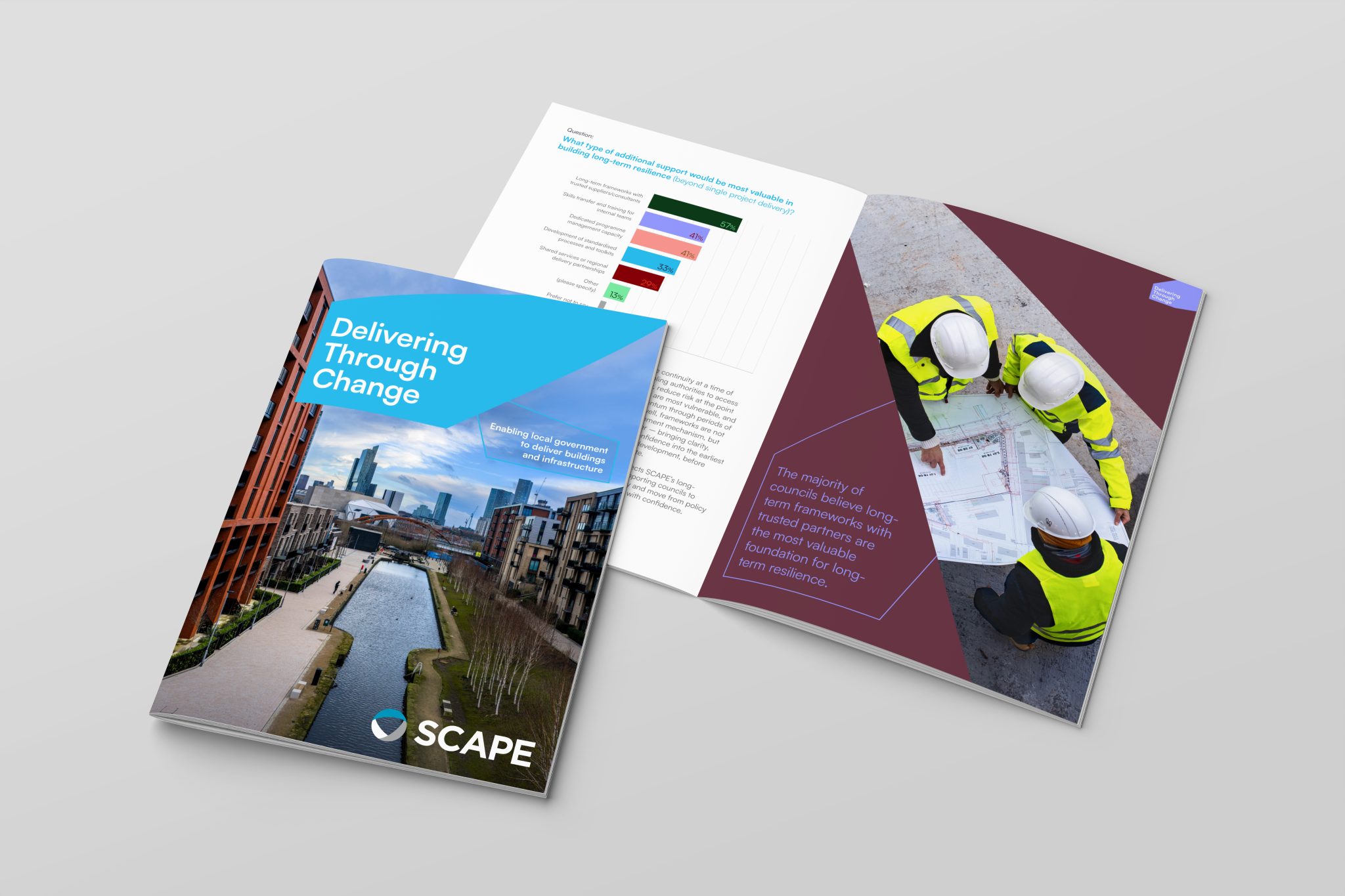
This article introduces a new report from SCAPE, in partnership with LGIU, that explores how councils across England are responding to growing financial pressures and service demands. Based on insights from 70 senior officers across 63 authorities, Delivering Through Change highlights both the challenges and the solutions shaping local delivery. You can read the full report here.
Local authorities are operating under extraordinary pressure. Economic turbulence, shifting national policy and the prospect of local government reorganisation (LGR) are converging to create an exceptionally challenging delivery environment, particularly when it comes to infrastructure and capital projects. Councils are not only expected to remain resilient in the face of this uncertainty, but are expected to deliver at pace, and at scale, on some of the government’s most ambitious agendas.
Local authorities have been tasked with accelerating housing delivery, driving major regeneration programmes, upgrading critical transport provision, and delivering social and community infrastructure, all while managing rising demand for services and severe financial constraints. The government’s agenda is built on the belief that local government can be the engine of place-based growth and we know that councils are deeply committed to fulfilling that role.
As we see firsthand, there is no shortage of ambition. Local authorities want to deliver for their communities, and they want to drive forward the UK’s place-shaping priorities. But rising construction costs, volatile markets, recruitment challenges and stop–start policy cycles are all reshaping their ability to plan, procure and progress projects with confidence.

SCAPE
To deepen our understanding of these pressures – as well as to help central government and delivery partners understand not only the challenges but also the solutions – SCAPE partnered with LGIU to conduct a major new piece of research. Our report, Delivering Through Change, captured the views of 70 senior officers across 63 councils in England, with the aim of providing an evidence base that supports better understanding, better decision making and stronger collaboration locally and nationally.
As expected, the research confirmed experiences that will be familiar to many in the sector. More than 40% of senior officers do not believe their council is currently well-positioned to deliver on its infrastructure and capital project ambitions. The same proportion say they are not confident they will be able to maintain delivery momentum over the next two years, given the current policy and funding environment. These concerns are not abstract: as the data reveals, they manifest in delayed projects, slowed progress and increasing risk.
The research also revealed that early-stage disruption is one of the most significant barriers to successful delivery. Around four-fifths (81%) of councils say that when they face constraints, projects struggle to move beyond the business case stage. Disruption most commonly occurs during scoping, planning, business case development and procurement – the crucial phases that determine whether a project ever reaches site. Cost inflation and market volatility were identified as the leading causes of these constraints, cited by 64% of respondents.
The nuances in the data are also revealing. For example, while many councils recognise the potential long-term benefits of local government reorganisation, their immediate concern is what happens in the meantime. A sizeable proportion of councils fear LGR will negatively affect their ability to deliver capital and infrastructure projects in the short term, with concerns that governance, procurement routes and project teams risk being disrupted at precisely the moment stability is most needed.
Skills shortages also emerged as an acute challenge, which chimes with SCAPE’s previously published insight report – A Year of Change: Public Good, Public Building – into councils’ most pressing needs. 40% of respondents to Delivering Through Change identified gaps in commercial and early-stage expertise as a major barrier to delivery. Without the right skills in place, early-stage work becomes slower, riskier and more resource-intensive. This compounds the uncertainty already caused by national economic conditions.
The financial consequences of these pressures are stark. Nearly four in five officers (79%) reported rising costs or budget overruns, while 64% reported project delays as the most common outcomes of economic upheaval. Crucially, 94% of respondents called for greater funding certainty or longer multi-year settlements, a clarion call from the sector on what is most urgently required to improve planning and delivery. Interestingly, this need is corroborated by LGIU’s ‘State of Local Government Finances’ research, also published this week, which found that 15% of the sector are likely to need Exceptional Financial Support (EFS).

SCAPE
Despite these challenges, councils remain clear-eyed about what would help. Their top priorities for building long-term resilience include skills transfer and training (41% of respondents), and trusted long-term frameworks, selected as the single most valuable support mechanism by 57% of those surveyed.
For our part, SCAPE is committed to providing exactly this kind of continuity, stability and early-stage support. We will continue to strengthen procurement resilience, invest in early-stage expertise and offer long-term frameworks that help councils maintain momentum through periods of change. Working with our 24 construction, civil engineering, consultancy and utilities partners, we have helped the public sector save over £118m in the last five years alone through smarter procurement. We are focused on giving councils the confidence, capability and certainty they need to deliver for their communities, informed by the results of this research.
Delivering Through Change provides a clear roadmap for how the sector, central government and delivery partners can work together more effectively. The challenges are significant, but with the right support, councils can and will continue to deliver the vital infrastructure the country depends on.
Was this article helpful or relevant for you?


